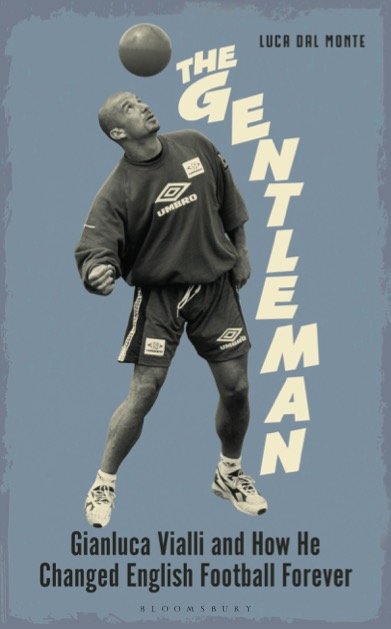
When The Gentleman reaches its final page, what remains is not a list of trophies nor a sequence of matches replayed by memory. What remains is a presence. Gianluca Vialli’s legacy does not reside only in what he won – though he won a lot – but in how he moved through football, and life, leaving things subtly altered behind him.
Vialli arrived in England at a moment when English football itself was changing. The game was rediscovering Europe, opening its door to new ideas, new habits, new ways of thinking. He did not arrive as a conqueror, nor as a foreign star asking to be indulged. He arrived with curiosity, humility and an uncommon intelligence for the world he was entering. He listened, learned and then, quietly, began to lead.
His influence was never purely tactical, though he understood the game deeply. It was cultural. He brought with him an Italian sense of preparation, of detail, of collective responsibility, but he never imposed it. Instead, he translated it. He adapted it to English football’s rhythms, traditions, dressing rooms. In doing so, he helped build a bridge between two footballing worlds that had long looked at each other with suspicion, sometimes even with prejudice.
As a player, he embodied generosity. As a manager, he embodied trust. He believed in people often before they fully believed in themselves. He demanded standards, but never theatrics. Authority for him did not need to be raised, it was simply exercised. Those who played with him or for him often speak not of fear but of respect, not of orders but of conviction.
Beyond football, Vialli really represented something rarer still: a way of being. He showed that ambition and kindness are not opposites. That competitiveness does not require cruelty. That leadership can be firm without being loud. In an era increasingly dominated by image, he remained stubbornly authentic. He did not perform himself; he was himself.
This book follows him across borders – geographical, sporting, cultural. But in truth, the most important journey Gianluca made was always inward. Vialli never stopped questioning himself, refining himself, learning. That restlessness, that refusal to settle into a finished version of who he was, may be his most enduring lesson.
For English football, he was not simply a successful foreign import. He was part of a broader evolution: proof that openness enriches rather than dilutes, that exchange strengthens identity rather than erasing it. For Italian football, he was a reminder that tradition is not something to defend by closing ranks, but something to carry with confidence into the world. And for those of us who knew him, or simply watched him closely, he leaves behind a quieter inheritance: the sense that decency still matters, that intelligence still counts, and that grace – on and off the pitch – is never out of fashion.
“He did not perform himself; he was himself.” From The Gentleman